
Foam is one of those formats that looks like a detail and behaves like a specification. A cleansing foam, a hair mousse and a whipped dessert topping are all dispensed from a can that resembles an ordinary aerosol, but the valve and the actuator are doing something different from a spray: they are turning a liquid or emulsion into a structure as it leaves the can.
That means the decision that governs the project is not the can diameter or the print. It is the valve assembly, chosen together with the actuator — and in the food case, the internal lacquer as well. This page covers the sizes we make and what has to be settled alongside them.
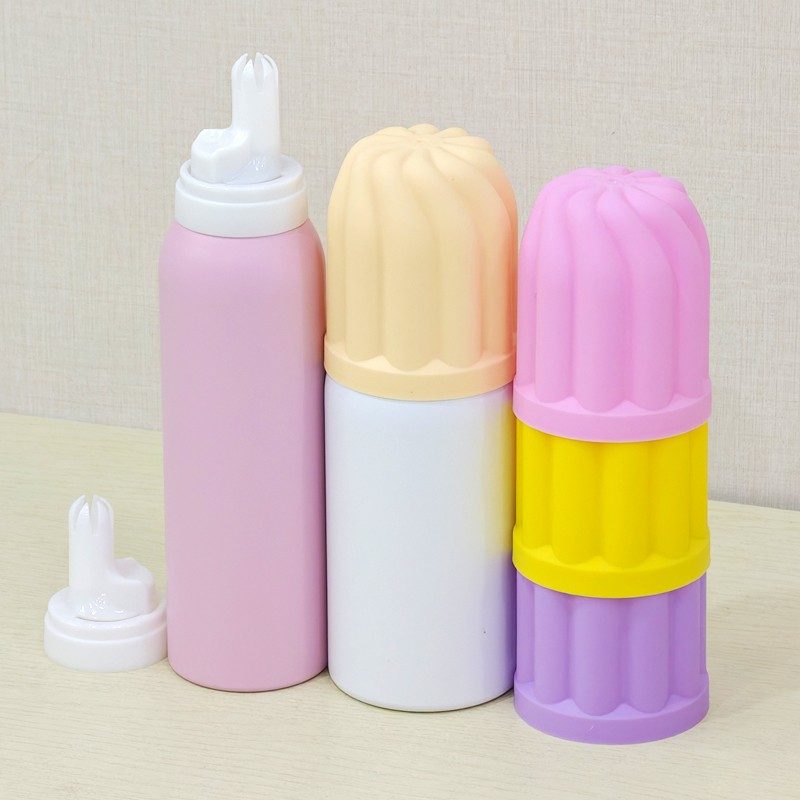
The foam formats we make
| 150 ml | Cream foam valve Cosmetic mousse, facial foam, cleansing foam |
|---|---|
| 200 ml | Cream foam valve Hair mousse, shaving foam, styling foam |
| 300 ml | Food foam valve Whipped cream, dessert foam, food mousse |
A mousse nozzle with a petal cap is available as a component for these sizes, so the valve, nozzle and cap can be supplied as one matched assembly. Sourcing them separately is the most common way a foam project loses time: a valve and an actuator that were never tested together will produce a different foam from the sample that was approved.
Why the valve, not the can, sets the format
- The valve is matched to produce foam. The cream and food foam valves used here are a different assembly from the fine-mist and continuous valves used on our cosmetic spray cans, and they are not interchangeable.
- The actuator shapes what is dispensed. The nozzle determines the form the foam takes as it leaves the can, which is why the two are specified as one set.
- The body is the same. Below the opening, the 150 ml, 200 ml and 300 ml cans are one-piece seamless aluminium bodies built on the same 1-inch (25.4 mm) crimp as the rest of the range — 99.5% aluminium, no side seam, no plastic liner.
- Pressure is conventional, not high. A foam format does not require the high-pressure construction used for fire suppression and portable oxygen, and specifying it would add cost for no benefit.
Food foam and cosmetic foam are not the same specification
The can body can serve both, and the 300 ml food foam size and the 150 ml cosmetic size are built the same way. What must not be treated as interchangeable is everything in contact with the product.
- Food foam. Uses a food-grade internal lacquer, and the food-contact documentation has to exist for the specification you are buying. Our food-contact article sets out exactly what our coating and migration reports do and do not cover — including the one that is issued to the lacquer manufacturer rather than to us.
- Cosmetic foam. Uses the same food-grade coating, but the food-contact documentation belongs to the food specification. What still has to be checked is that the product itself suits the coating over the shelf life claimed — an aggressive or alcohol-based cleanser is a different proposition from a whipped dessert.
Which lacquer suits a given foam is settled on this range by two fixed choices: the valve is the standard 1-inch (25.4 mm) valve, and the internal coating is food-grade. That combination is what allows the same body to serve a dessert foam and a cleansing foam — the difference between them is the specification and the documentation that goes with it, not the metal.
Testing and documentation
- Leak testing — 100% of production, water-bath immersion, every can.
- Pressure and burst testing — sampled per batch, recorded against the batch number.
- Coating adhesion — tested on internal and external coating after curing.
- Print colour control — matched against the approved Pantone reference each run.
- Batch traceability — material batch and production batch recorded and retained.
- Food-contact compliance — internal lacquer declaration available for food and oral products, on the food foam specification.
Frequently asked questions
What is the difference between a foam can and a spray can?
The valve assembly and the actuator. On a foam format the valve is matched to expand the product into foam as it leaves the can, and the nozzle or actuator shapes the foam that is dispensed. The can body itself is built the same way as our other aluminium aerosol cans, on the same 1-inch (25.4 mm) opening.
Can one can size be used for both food and cosmetic foam?
The body can, but the specification should not be treated as interchangeable. For food use the internal lacquer has to suit the product and the food-contact documentation has to exist; a cosmetic foam does not carry that requirement. The same 300 ml D53-sized can can be supplied for whipped cream and the same 150 ml size for a facial cleansing foam, but each is specified for its own product.
Which size suits a cake or dessert foam?
The 300 ml food foam can with a food foam valve is the size we make for whipped cream, dessert foam and food mousse. The 150 ml and 200 ml sizes use cream foam valves and are intended for cosmetic and personal-care foams such as cleansing foam, hair mousse and shaving foam.
Do you supply the mousse nozzle and cap?
Yes. A mousse nozzle with a petal cap is available as a component so the valve, nozzle and cap are supplied as one matched set rather than assembled from different sources.
What is the minimum order quantity?
Our standard MOQ is 10,000 pieces per size and design. Smaller trial quantities can be discussed for a first production run, and free blank samples are available so you can test the foam character with your own formulation.
Next step
Send the formulation, the fill volume and the foam character you are trying to achieve — dense and short, or light and long-lasting. The foam character is decided by the valve and actuator together, so that is the part worth getting right before artwork. The sizes are on the product pages, or you can ask about mousse and foam cans directly.