
Fire suppression spray and portable oxygen are different products that ask the same thing of their packaging. Both hold a higher internal pressure than a cosmetic aerosol. Both are expected to work after sitting in a vehicle or a cupboard for years. And both carry warnings that have to remain legible for the whole of that time.
That combination rules out a good deal of packaging before cost enters the conversation. This page covers the sizes we make for these two applications, what changes on the can side, and how pressure is verified before the cans leave.
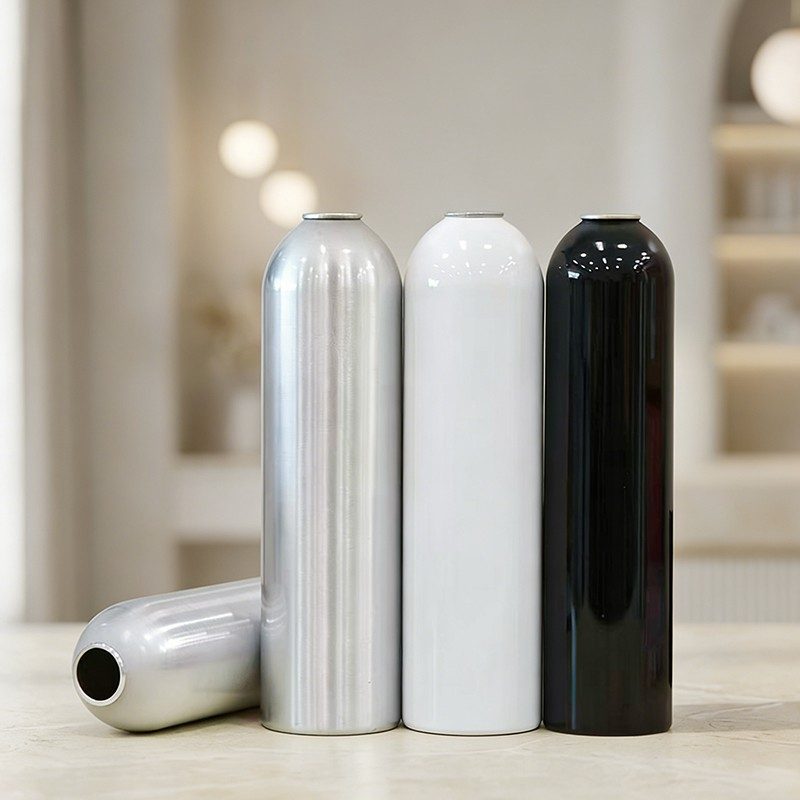
The sizes we make
| 100 ml | High pressure · silver Portable oxygen, compressed air |
|---|---|
| 300 ml | High pressure · white, silver or black Portable oxygen, compressed air |
| 500 ml | High pressure · silver, white or black Portable oxygen, compressed air |
| 400 ml | High pressure · trigger valve option Fire extinguishing agent |
| 500 ml | High pressure · printed body Fire suppression spray |
| 600 ml | High pressure · silver or blue Fire suppression spray |
The wider range is drawn from 22 mm to 66 mm in diameter and 90 mm to 300 mm in height, so a high-pressure project is not confined to these six sizes — but a change of diameter or height changes the pressure behaviour and has to be treated as a new specification rather than a variant.
What is different about the can
- One-piece seamless body. The can is impact-extruded in 99.5% aluminium as a single piece, so there is no side seam. On a pressure vessel this is the structural argument for aluminium: the failure path that a welded or soldered seam would introduce simply does not exist.
- No plastic liner. Nothing inside the can that can degrade, peel or react over a long storage life.
- Light weight. An aluminium body keeps the filled unit light enough to be carried, which is the entire point of a portable oxygen canister or a vehicle fire extinguisher.
- Direct printing. Warnings, hazard pictograms and flame graphics are printed onto the metal in up to 9 colours, so nothing has to stay stuck for the life of the product.
Valves and the crimped joint
Every can in this range uses the standard 1-inch (25.4 mm) opening, supplied as continuous or metered as the application requires, with a trigger valve option on the 400 ml fire suppression can.
The crimped joint between valve and can is the seal that matters most on a pressure product, which is why the valve is specified together with the can rather than sourced independently. Which valve elastomer and gasket suit a given agent — a dry chemical, a clean agent, a compressed gas — is a compatibility question, and on this range it is answered by the valve type: high-pressure cans use a high-pressure valve rather than the standard 1-inch valve used elsewhere in the range, and the valve and the can are specified as one assembly, because the crimped joint between them is the seal that carries the pressure.
How pressure is verified
- Leak testing — 100% of production, water-bath immersion, every can.
- Pressure testing — sampled per batch and recorded against the batch number.
- Burst pressure testing — sampled per batch, results reported on request.
- Dimensional control — in-line diameter, height and shoulder checks during forming.
- Batch traceability — material batch and production batch recorded and retained, so a pressure record can be traced to the cans it covers.
If a specific market requires a pressure-vessel test certificate, or a transport classification document for the filled unit, that requirement sits with the product rather than the empty can. Tell us the destination and we will tell you which parts of that set we can support and which you need to obtain elsewhere.
Where the responsibility sits
Fire-extinguishing agents and breathing oxygen are regulated in most markets, and in some they are regulated heavily — approvals, labelling, transport classification and end-use restrictions all apply. We supply the packaging: the can, the valve and the cap. Meeting the rules that apply to the filled product, in the market it is sold into, is the brand's responsibility. We state that clearly here because a supplier who glosses over it is not doing you a favour.
Frequently asked questions
What does 'high pressure' change about the can?
It changes what the can has to withstand and therefore how it is specified, not the material. Every can in this range is a one-piece seamless aluminium body in 99.5% aluminium, so there is no side seam — and no seam is a joint that can fail. Pressure and burst performance is then verified per batch rather than assumed.
Can you supply a trigger valve for a fire extinguisher?
Yes. The 400 ml fire suppression can is offered with a trigger valve option, and the 500 ml and 600 ml cans are supplied as high-pressure bodies with continuous valve configurations. The valve is specified together with the can because the crimped joint is the seal that matters most.
Do you supply the extinguishing agent or the oxygen?
No. We supply packaging. Fire-extinguishing agents and breathing oxygen are regulated products, and the obligation to meet the rules of the destination market — including any approval, labelling or transport requirement — rests with the brand filling the can, not with the can supplier.
What pressure documentation do you provide?
Pressure testing is sampled per batch and recorded against the batch number, and burst pressure testing is sampled per batch with results reported on request. If you need the figures for a specific order, tell us the batch reference and we will issue the record against it.
Can the can be printed with warning text and pictograms?
Yes. Printing goes direct onto the body in up to 9 colours by offset lithography or silkscreen, so warning text, hazard pictograms and flame graphics form part of the artwork rather than a label. On a high-pressure product that matters: a label is a second thing that can come off.
Next step
Tell us the agent or gas, the fill pressure you are working to, the size you need and the market you are selling in. We will come back on can specification and valve together, and be straight about which documents we can issue. The sizes are on the product pages, or you can ask about high-pressure cans directly.