
Cooking spray looks like an ordinary aerosol until you follow the product path. The oil touches the internal lacquer, sits against the valve stem and is drawn up the dip tube — or, in a bag-on-valve can, never touches any of them. Every one of those surfaces is therefore part of the food-contact question, and each has to be specified rather than assumed.
This page covers the three formats we make for food use, the reason bag-on-valve dominates the category, and the documents involved — including a plain account of what our reports cover and what they do not.
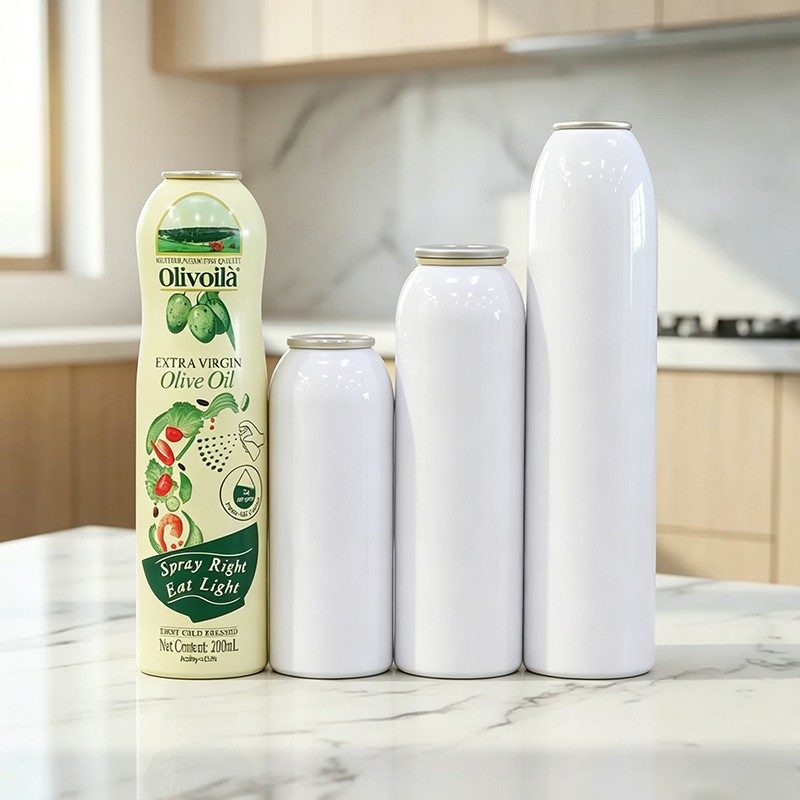
The food formats we make
| 200 ml | Food-grade coating · cooking spray Olive oil, extra virgin olive oil |
|---|---|
| 300 ml | BOV · food-grade coating Cooking oil, vegetable oil, grilling spray |
| 300 ml · D53 × H200 mm | Food foam valve · 1-inch neck Edible oil mousse, culinary foam |
The 300 ml edible-oil mousse can is quoted as a drawn size — 53 mm diameter, 200 mm height, round shoulder and a 1-inch (25.4 mm) neck — because for a foam format the geometry and the valve have to be fixed together. Across the wider range the body can be drawn from 22 mm to 66 mm in diameter and 90 mm to 300 mm in height, so a food product is not restricted to these three sizes if the run justifies it.
Why bag-on-valve is the usual answer in food
- The propellant never contacts the oil. In a conventional can the propellant shares the headspace with the product and is dispensed with it. In a BOV can the product is held in a sealed bag and the propellant applies pressure from outside, so what leaves the nozzle is the formulation alone.
- It sprays from any angle. A bag does not need gravity to feed a dip tube, so a grill pan or a salad bowl can be sprayed from whichever position is convenient.
- Near-complete evacuation. The bag collapses instead of the headspace growing, which leaves less oil behind in the can.
- Viscous products become practical. Thicker oils and emulsified culinary products that would struggle up a dip tube can be delivered from a bag.
It costs more per can, and your filler has to be set up for the assembly — BOV valves are crimped and gassed in one operation. Both points are worth knowing before the specification is fixed, and we would rather say so than let the format be chosen on price alone.
The internal coating is the part that gets specified wrongly
The internal lacquer is what stands between the aluminium and the food, and it is chosen for the product rather than for the range. A food-grade lacquer is available on request, and a declaration of the material used on your order can be issued with it.
What the coating has to resist depends entirely on the formulation: acidity, salt, alcohol and flavour oils all attack different lacquers at different rates. So the useful conversation is not "is the can food-grade?" but "does this lacquer suit this product, for the shelf life you are claiming and the market you are selling in?" That is answerable, but only with the formulation in hand.
What the reports actually cover
Three documents are relevant here, and one of them is routinely misread. Being blunt about the boundaries is more useful than quoting certificate numbers:
- Coating report — A2260041275101001E, issued by CTI Testing (Centre Testing International) to PPG Coatings, covering the PPG2845 lacquer material tested to GB 4806.10-2025. It demonstrates the material's performance. It is not issued to us and it does not certify our finished cans.
- Heavy metals and PFAS report — DLR-260711013R, from Shenzhen DL Testing, on aluminium aerosol can samples: Pb, Hg, Cd, Cr(VI), total fluorine and PFAS — all pass.
- SGS test report — GZHL241105081201CW, from SGS-CSTC Standards Technical Services (Guangzhou Branch), on aluminium can samples. It covers generic can samples and is not tied to your order.
If a report needs to carry your batch number, tell us the batch reference on the order and we will issue the documents against it — material batch and production batch are both recorded and retained, so the paperwork can be traced back to the specific cans that were made for you.
How to read our test reports goes through the five fields that decide whether any report is worth anything, ours or another supplier's.
Testing and documentation
- Leak testing — 100% of production, water-bath immersion, every can.
- Pressure and burst testing — sampled per batch; burst results reported on request.
- Coating adhesion — tested on internal and external coating after curing.
- Food-contact compliance — internal lacquer declaration available for food and oral products.
- Heavy metal / migration — third-party laboratory testing on request for regulated markets.
- Recyclability — the aluminium body is 100% recyclable, with no plastic liner in standard cans.
Frequently asked questions
Which document proves the cans are food-safe?
No single document proves that, and it is worth being precise. We hold a coating report issued to PPG Coatings for the PPG2845 lacquer material, tested to GB 4806.10-2025 — it covers the lacquer, not our finished cans. We also hold third-party heavy metal and PFAS results on aluminium can samples. A declaration of the internal lacquer used on your order is available on request, and we will send the documents that exist rather than a summary of them.
Why is bag-on-valve used so often for cooking oil?
Because it keeps the propellant out of contact with the oil. In a conventional can the propellant shares the space with the product and becomes part of what is dispensed. In a bag-on-valve can the oil stays inside a sealed bag, and the propellant provides the pressure from outside it. For a food product that separation is usually the whole point.
Can the same can be used for olive oil and for a mousse?
The body can, with different valve assemblies. The 200 ml and 300 ml spray cans discharge as a spray, while the 300 ml D53 × H200 mousse can uses a foam valve for culinary foam and whipped oil. The internal coating requirement depends on the product and how it will be used.
What is the minimum order quantity?
Our standard MOQ is 10,000 pieces per size and design. Smaller trial quantities can be discussed for a first production run. Free blank samples are available for your own fill and spray tests.
Is food-contact compliance guaranteed once I buy your cans?
No, and we will not imply otherwise. Food-contact compliance depends on your formulation, your filling process and the rules of the market you sell in, as well as on the packaging. What we can do is supply the packaging on a repeatable specification and give you the documentation that supports it.
Next step
Send the product, its acidity or alcohol content, the shelf life you are claiming and the market you are selling in. We will come back on the lacquer and the valve together, and tell you plainly if the documentation you are asking for is not something we can issue. The food sizes are on the product pages, or you can ask about food-contact cans directly.