
Disposable car fresheners look like a simple product and behave like a metered one. The user presses once, expects a short burst, and leaves the can in a cup holder or clipped to a vent. What makes that work is not the body: it is the valve that meters the charge and the actuator that decides how the released product disperses.
This page covers those two components and the decisions that sit on top of them, from the component side rather than the can side.
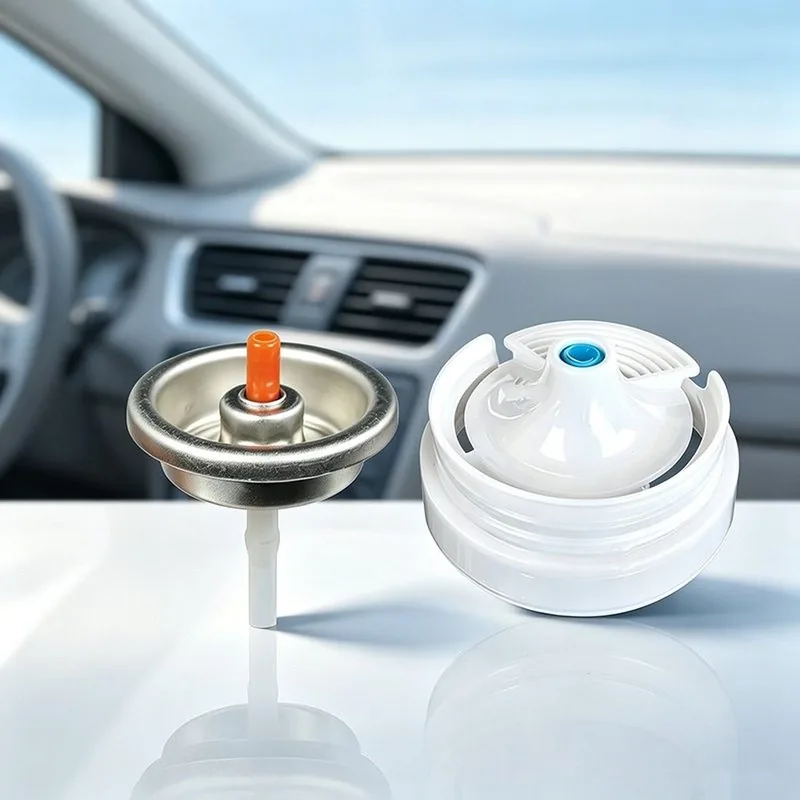
What a single-use format asks of the component
| One short burst per press | Valve and actuator A metered charge, not a continuous valve |
|---|---|
| Dispersal rather than aim | Diffuser actuator The released product spreads from a fixed position instead of being directed |
| Light press force | Valve spring and actuator The format is usually pressed with a fingertip in a confined space |
| Stays clean between uses | Cap and actuator The actuator face is exposed while the can is in place |
| Low cost per unit | Body, valve and actuator together A disposable format supports a smaller body and a simpler component set |
Because the format is disposable, the temptation is to treat the component set as a commodity. That is where single-use formats most often go wrong: a valve and an actuator that were never tested as a pair produce a burst that differs from the approved sample, and the difference is only visible once the product is on a shelf.
Spray or diffuser: the decision that shapes the rest
- A diffuser actuator suits a can that is left in place. The product is expected to disperse on its own, so the component releases it in a form that spreads rather than one aimed at a target.
- A spray actuator suits a format the user aims. If the product is expected to be directed, a conventional spray actuator is the right component, and the plume geometry becomes part of the specification.
- Either way the valve is the other half of the pair. The metered charge, the spring force and the actuator stroke are one assembly in practice. Our article on valve sizes sets out how the crimp opening constrains which of these exist for your project.
What to settle before asking for a quote
- Number of uses and conditions. The fill volume and propellant follow from how long the product has to last and where it is kept.
- Diffuser or spray, and the release character you want from each press.
- Press force if the format is used in a confined space or fired by hand from a clip.
- Cap and retention. What keeps the actuator clean and prevents accidental actuation in a vehicle.
- Decoration. Printing is done in-house by offset lithography and colour-matched against your approved Pantone reference, so the artwork and the component can be settled in the same conversation.
Frequently asked questions
What is the difference between a spray actuator and a diffuser actuator?
A spray actuator releases the product as a plume directed at the air in front of it, while a diffuser actuator releases it in a form that disperses from a fixed position rather than towards a target. For a disposable car format the diffuser type is the one normally specified, because the can is left in place and the product is expected to disperse by itself.
How many uses does a disposable car freshener give?
That is set by the fill volume, the propellant charge and the dose per actuation, not by the container alone. Send us the number of uses you want and the conditions the product is kept in, and we will confirm the body and the valve against it.
Which size can a disposable car freshener use?
The body is chosen from the small sizes this range already covers, starting at 15 ml, and then confirmed against your fill volume and propellant. We would rather confirm the body against your numbers than quote a size before the dose is settled.
Can the actuator be locked or tamper-evident?
Self-locking and other safety arrangements are available as actuators in this range. Whether a locking actuator is appropriate depends on how the product is sold and carried; tell us the requirement and we will confirm what is available for the opening you are using.
Do you supply the can, the valve and the actuator together?
Yes, as a matched set on the standard 1-inch (25.4 mm) opening. Sourcing the valve and the actuator separately is the most common reason a disposable format ends up with a burst that does not match the approved sample. Our standard minimum order quantity is 10,000 pieces per size and design, and free blank samples are available for testing.
Next step
Send us the number of uses, the release character and the press force you have in mind, and we will confirm the valve and actuator pair and the body that fits it, with free blank samples for testing. The components we supply are listed under components and accessories; if the product is intended for a room rather than a car, see the tinplate air freshener article. You can also contact us directly.